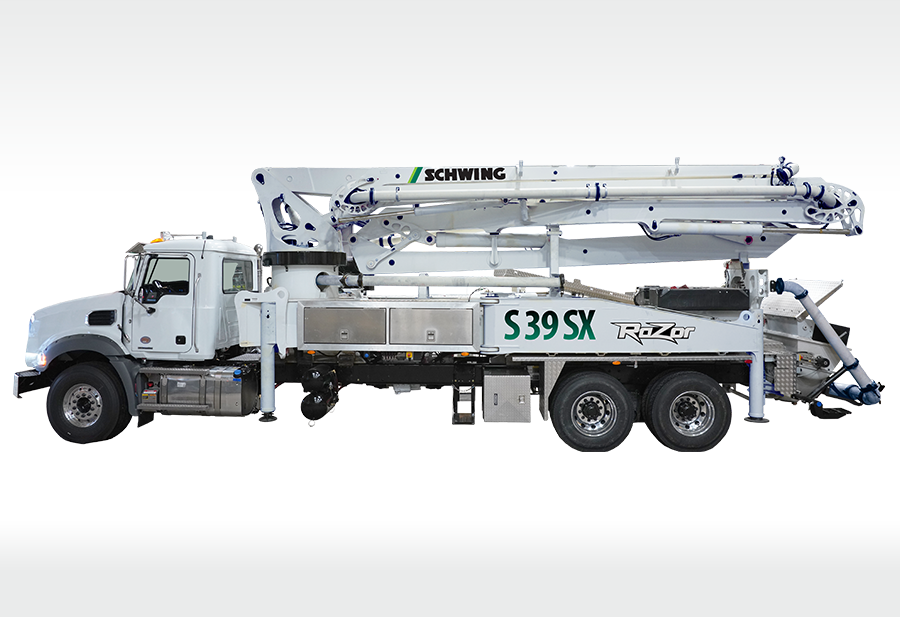
Stationary Placing Boom Financing Program overview
Pricing basis: boom reach, hours, resale strength
Application-only: up to $500,000
Sellers: dealer, auction, or private party
Turnaround: same business day
Get a Quote Back to list
Pick the position, bolt the mast to the structure, and pour from it for the life of that level. A stationary placing boom is the straightforward, proven way to handle concrete distribution on a building where the floor plate is larger than a truck boom can reach and the pour sequence repeats level after level. No crane pick to reposition, no climbing mechanism to maintain, no moving the machine. Just a fixed column, a hydraulic boom, and a crew that knows where the hose ends up on every pour day.
Stationary placing booms are cheaper to buy and simpler to operate than self-climbing units, and they make sense on the majority of mid-rise and high-rise projects where the building's pour cycle allows time to re-rig at each level. We finance these machines for concrete subs, GCs self-performing, and rental operations serving the tower market. The deal is usually cleaner than a climbing system, and it closes faster.
Configurations and Mounting Options Column Mount vs. Mast Mount Most stationary placing booms mount to a structure. The standard approach is a collar or bracket clamped around a concrete column, with the boom rotating freely on a slewing ring at the top of the mounting assembly. The height of the mount determines the working radius coverage. As the building rises, the mounting bracket is moved up one floor at a time, a straightforward operation that a small crew handles without special equipment beyond a crane pick for the boom head.
On jobsites without a structure to mount to, a freestanding mast with a ballasted base provides the same function. Precast yards, tilt-up production facilities, and industrial slab pours where the pump feeds a fixed location all use this configuration. Freestanding masts require more setup time and a larger footprint, but they go anywhere and can be repositioned on the yard between projects.
Reach and Capacity Stationary placing booms are available in reach configurations from about 17 meters (suitable for smaller industrial slabs) up to 50-plus meters for large commercial towers. The most common range for mid-rise and lower high-rise work is 24 to 38 meters. At 32 meters of horizontal reach, a boom mounted at the core of a typical residential tower floor plate can cover the full slab from a single anchor point. Larger booms cover wider floor plates or provide redundancy when placement needs to reach building corners the core-mounted position cannot serve.
Output capacity matches what the pump delivers. A stationary boom is a passive distributor; it does not pump, it directs. The pump's output determines placement rate, not the boom. That means a single placing boom can serve a high-output high-pressure concrete pump delivering 90-plus cubic meters per hour just as readily as it serves a lower-output unit. The hose tip and operator are the actual rate limiters.
Where Stationary Placing Booms Are Working Right Now The mid-rise residential construction wave across the Southeast and Sun Belt has been a steady source of stationary placing boom demand. Markets like Nashville , Charlotte , and Austin have sustained high volumes of 10 to 25 story mixed-use and residential projects where a stationary boom is the right tool. These projects are typically not tall enough to justify a climbing system but definitely require something beyond a truck boom that cannot reach the upper floors.
Industrial construction has been another strong driver. Warehouse and distribution center construction requiring large monolithic slab pours, often 100,000 square feet and up in a single pour, benefit from a fixed mast unit positioned at the center of the pour area. The boom rotates through 360 degrees, the crew follows the discharge hose, and the pump feeds continuously. That is a productive day with a well-run crew and properly financed equipment.
Financing a Stationary Placing Boom The transaction is simple. The equipment has a purchase price, we write a loan for that price (or a portion of it with a down payment), and you make monthly payments over a 48 to 84 month term. The placing boom is the collateral. For most stationary units, which range from $80,000 for a used mid-size unit to $350,000 or more for a new large-reach model from a European manufacturer, the financing amount falls comfortably within our application-only range.
Application-only means no tax returns, no audited financials, no years of bank statements for many transactions under $400,000. The application asks for basic business information, the equipment spec and price, and authorization to pull credit. That is a meaningful simplification compared to a bank process, and it is why contractors who do not want to spend two weeks assembling a lending package come to us. See our application-only financing page for the specific terms.
Contractors who are placing booms alongside a simultaneous pump purchase should consider bundling both pieces into one loan. It simplifies the administrative side and can improve the overall rate by increasing the deal size. A combined pump and boom purchase also makes sense from a credit standpoint because the total asset package is more comprehensive collateral than either piece alone. See concrete boom pump financing if you are considering both pieces together.
Refinancing and Leaseback on Stationary Booms A paid-off stationary placing boom sitting in the yard between projects is idle capital. A concrete pump refinancing or sale-leaseback converts that asset into cash while the boom stays available for the next job. The refinancing path works if there is existing debt on the machine that you want to restructure to a better rate or longer term. The leaseback works if you want cash in hand and are comfortable making a lease payment on equipment you already own free and clear.
Either path requires the machine to have positive equity relative to the financing amount. A well-maintained stationary placing boom from a reputable manufacturer holds value well enough to support meaningful cash-out transactions on machines that are 5 to 10 years old with normal hours.
Questions We Hear Regularly From stationary placing boom buyers.
Get Your Stationary Placing Boom Funded Simple equipment, straightforward financing. Submit an application now or call us and we will have a number for you fast. We know the equipment, we know the market, and we fund in about one to two weeks from a complete application.
Common questions Can I finance a stationary placing boom for a single project and then return it? That is a lease structure, not a loan. We offer equipment leases with fair market value buyout options that let you return the boom at the end of the term if you do not have a use for it on future projects. If the project runs 18 months, a 24-month lease gives you coverage plus a short cushion. Call us and we will price both options.
How much does a used stationary placing boom depreciate compared to a new one? Like any major piece of concrete equipment, the first few years of useful life carry the steepest depreciation. A three-year-old unit from a major manufacturer in good condition typically trades for 60 to 75 percent of its new price. Beyond that, depreciation flattens for well-maintained units. Lenders use current market values when sizing used loans, so the loan amount on a used machine reflects realistic collateral, not optimistic asking price.
Can a startup concrete pumping business finance a stationary placing boom? Early-stage businesses can qualify. The owner's personal credit, any existing equipment or assets, and a credible project contract all help build the case. New-business financing typically requires a larger down payment and personal guarantee, but it is available. See our new-business startup financing page for specifics.
What if the placing boom is damaged on the job? Does the loan continue? The loan obligation continues regardless of the equipment's condition. That is why lenders require you to maintain property and casualty insurance on financed equipment with the lender named as additional insured. If the boom is damaged or destroyed, the insurance pays off the loan (or a portion of it), and you recover without a catastrophic financial loss. Do not let that coverage lapse.
Common Questions on Stationary Placing Boom Financing Straight answers before you send the equipment file.
Can I finance a stationary placing boom for a single project and then return it? That is a lease structure, not a loan. We offer equipment leases with fair market value buyout options that let you return the boom at the end of the term if you do not have a use for it on future projects. If the project runs 18 months, a 24-month lease gives you coverage plus a short cushion. Call us and we will price both options.
How much does a used stationary placing boom depreciate compared to a new one? Like any major piece of concrete equipment, the first few years of useful life carry the steepest depreciation. A three-year-old unit from a major manufacturer in good condition typically trades for 60 to 75 percent of its new price. Beyond that, depreciation flattens for well-maintained units. Lenders use current market values when sizing used loans, so the loan amount on a used machine reflects realistic collateral, not optimistic asking price.
Can a startup concrete pumping business finance a stationary placing boom? Early-stage businesses can qualify. The owner's personal credit, any existing equipment or assets, and a credible project contract all help build the case. New-business financing typically requires a larger down payment and personal guarantee, but it is available. See our new-business startup financing page for specifics.
What if the placing boom is damaged on the job? Does the loan continue? The loan obligation continues regardless of the equipment's condition. That is why lenders require you to maintain property and casualty insurance on financed equipment with the lender named as additional insured. If the boom is damaged or destroyed, the insurance pays off the loan (or a portion of it), and you recover without a catastrophic financial loss. Do not let that coverage lapse.
Get Terms on Stationary Placing Boom Financing Tell us what you are buying, who is selling it, and when you need it earning. We will review the file and point you to the next step.