Residential Foundation Contractors Program overview
Pricing basis: boom reach, hours, resale strength
Application-only: up to $500,000
Sellers: dealer, auction, or private party
Turnaround: same business day
Get a Quote Back to list
Foundation work does not wait. A residential builder puts the schedule on pour day and everything downstream moves from that date. A foundation contractor who owns their own pump never has to call three pumping subs hoping one shows up. The truck is in the yard, it goes to the job, the pour happens, the crew moves to the next one. That reliability is worth a monthly payment, and we make the payment work.
Residential foundation contractors are among the most consistent users of mid-range boom pumps and line pumps because the pours are repetitive, the volumes are predictable, and the reach requirements for most single-family and light multifamily work fall neatly into the 32- to 42-meter range. Our financing starts at $50,000, covers the new and used equipment range that residential contractors actually buy, and funds in about one to two weeks.
Foundation Contractors at Every Scale Residential foundation work covers a wide range of operations, from a two-person crew pouring footings for custom homes to a multi-crew operation running several subdivision developments simultaneously. The pump needs scale with the volume:
Single-crew contractors pumping footings and foundation walls for custom homes, additions, and small commercial slabs Subdivision contractors who pump foundations for production builders on rolling schedules, sometimes five to ten pours per week Contractors who pour both residential foundations and light commercial slabs and need a pump that handles both efficiently Foundation contractors adding a second pump to cover simultaneous pour days in different neighborhoods Contractors working on both foundations and general slab work often overlap significantly in their equipment needs, and a pump that handles both applications is a smart investment.
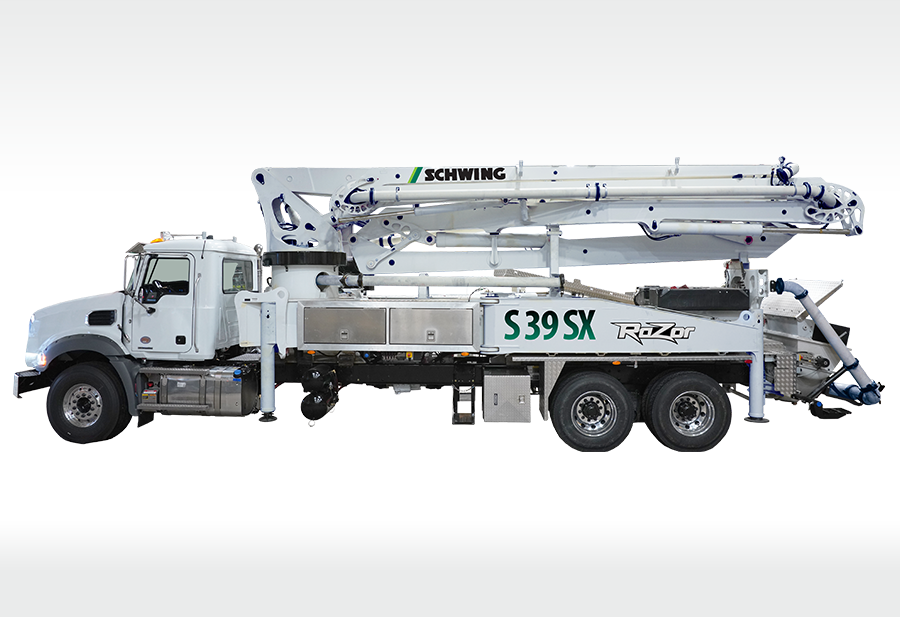
The Right Pump for Residential Foundation Work Most residential foundation pours do not require a 47-meter boom. A 32-meter boom pump reaches across most residential lots with room to spare and can place concrete in basements, crawl spaces, and frost wall configurations that chute delivery cannot handle. The 32-meter class is lighter, less expensive, and easier to maneuver through established neighborhoods with narrow streets and overhead wires.
Foundation contractors who also do flatwork, garage slabs, and light commercial work often step up to a 36-meter unit , which adds reach without a major jump in price or operational complexity. The step from 32 to 36 meters opens more of the commercial market without forcing a full step into the mid-range commercial boom class.
For contractors who primarily pour footings and walls with minimal elevated reach requirements, a trailer-mounted line pump or ball-valve line pump can serve the foundation work efficiently at a lower acquisition cost than a boom truck. The choice between a boom and a line pump for foundation work comes down to site access, volume, and whether the reach of a boom justifies its cost on the specific jobs being chased.
Payment Structures for Foundation Contractors Foundation contractors often have seasonal revenue patterns, particularly in northern markets where winter weather limits concrete placement. A payment structure that accounts for seasonal slowdowns is a legitimate request, and we work with lenders who offer seasonal payment structures that front-load lower payments in slow months and higher payments when the work is running hard.
For a 32- or 36-meter boom in the $100,000 to $130,000 purchase range, a 60-month loan at a competitive rate produces a monthly payment that most active foundation contractors can cover with the income from two or three additional pours per month compared to subcontracting the pump work. The math closes quickly for contractors who run consistent volume.
Used equipment is a particularly attractive entry point for residential foundation contractors. A used concrete boom pump in good working condition costs substantially less than new, and for contractors who want to test the economics of pump ownership before committing to a new-unit investment, used is a rational first step.
Getting Approved as a Foundation Contractor Residential foundation contractors sometimes have credit profiles that reflect the early years of building a business: a personal credit score that carries some history, business credit that is still being established, and revenue that has grown faster than the formal financial documentation suggests. We work with that reality.
B and C credit situations are considered. The application itself, supported by three months of business bank statements, is usually enough to move a transaction priced roughly $50k–$400k. We do not require tax returns for most transactions in our sweet spot. Our goal is to fund the contractor who has the business to support a payment, even if the credit score alone does not tell the full story.
Contractors in high-growth markets like Nashville , Raleigh , or Austin where residential construction is running hard typically have the revenue volume to support a pump payment comfortably, even with a credit file that has some roughness in it.
Foundation Contractor FAQs
Put Your Own Pump on the Job Foundation contractors who own their pump never scramble for placement on a pour day. Get a pre-approval decision today on a boom pump or line pump purchase. New, used, first unit, or fleet addition. Apply online or call us directly to get the process started.
Common questions I am a one-person foundation contractor. Am I too small to qualify? No. Owner-operators and single-crew foundation contractors qualify regularly. The application looks at your revenue relative to the proposed payment, not the size of your workforce. If the numbers work, the transaction works.
Can I finance a line pump instead of a boom truck? Yes. Line pumps, trailer-mounted pumps, and boom trucks are all within our program. The minimum transaction is $50,000 and the asset needs to have collateral value. Many foundation contractors start with a line pump and later step up to a boom.
My foundation business is seasonal and my bank statements show slow months. Will that hurt my approval? Seasonal revenue is a known pattern in foundation contracting and the lenders in our network understand it. We look at the full-year pattern, not just the last 30 days. A slow winter following a strong fall and spring is a normal profile in this business.
Can I get no-money-down financing on a used boom pump? No-money-down programs exist but are typically reserved for strong credit profiles or newer equipment. On used equipment, a small down payment is common. We discuss what is realistic given your specific credit profile before any commitment is made.
The pump I want is in another state and I need to pay the seller before I can transport it. How does that work? For private-party purchases, we fund directly to the seller after the title and lien check is complete. You do not need to pay out of pocket first. The seller is paid at closing, and you take possession from there.
Common Questions on Residential Foundation Contractors Straight answers before you send the equipment file.
I am a one-person foundation contractor. Am I too small to qualify? No. Owner-operators and single-crew foundation contractors qualify regularly. The application looks at your revenue relative to the proposed payment, not the size of your workforce. If the numbers work, the transaction works.
Can I finance a line pump instead of a boom truck? Yes. Line pumps, trailer-mounted pumps, and boom trucks are all within our program. The minimum transaction is $50,000 and the asset needs to have collateral value. Many foundation contractors start with a line pump and later step up to a boom.
My foundation business is seasonal and my bank statements show slow months. Will that hurt my approval? Seasonal revenue is a known pattern in foundation contracting and the lenders in our network understand it. We look at the full-year pattern, not just the last 30 days. A slow winter following a strong fall and spring is a normal profile in this business.
Can I get no-money-down financing on a used boom pump? No-money-down programs exist but are typically reserved for strong credit profiles or newer equipment. On used equipment, a small down payment is common. We discuss what is realistic given your specific credit profile before any commitment is made.
The pump I want is in another state and I need to pay the seller before I can transport it. How does that work? For private-party purchases, we fund directly to the seller after the title and lien check is complete. You do not need to pay out of pocket first. The seller is paid at closing, and you take possession from there.
Get Terms on Residential Foundation Contractors Tell us what you are buying, who is selling it, and when you need it earning. We will review the file and point you to the next step.