Boom Pump Financing in St. Louis, MO Program overview
Pricing basis: boom reach, hours, resale strength
Application-only: up to $500,000
Sellers: dealer, auction, or private party
Turnaround: same business day
Get a Quote Back to list
St. Louis does not always get credit for being the construction market it is, but the numbers are there. BJC HealthCare, one of the largest hospital systems in the country, runs a perpetual construction and renovation program across its Barnes-Jewish, St. Louis Children's, and regional campuses. Boeing's defense manufacturing presence in St. Charles County generates ongoing industrial concrete work. The suburban build-out in West County, St. Charles, and Jefferson County keeps residential and commercial concrete demand steady. And the downtown and midtown redevelopment, from the Cortex Innovation District to the Central West End, keeps urban pumpers on active job sites. We finance concrete boom pumps and pump equipment for operators working the St. Louis metro and surrounding Missouri and Illinois areas, starting at $50k with closings in one to two weeks.
St. Louis: The Construction Behind the Headlines The BJC HealthCare system's ongoing expansion at Barnes-Jewish Hospital and Washington University Medical Campus in the Central West End is one of the most sustained institutional construction programs in the region. The medical campus has been adding research towers, clinical buildings, and patient care facilities for years. These structures require concrete work that ranges from large slab foundations to the elevated structural work on taller medical towers. Commercial construction in the Cortex Innovation District, adjacent to the Washington University medical campus, has added tech office, lab, and mixed-use development that creates additional pumping demand in the same neighborhood.
Boeing's operations at the St. Louis Defense and Space facility in St. Charles County involve periodic industrial renovation and expansion that generates concrete work. The broader manufacturing and industrial corridor in St. Charles and Lincoln counties, along with the logistics development along I-70 and I-44, adds flatwork and industrial slab volume that industrial-focused pumpers can access without leaving the region.
The historic renovation market in St. Louis is also more active than most cities its size. St. Louis has a significant stock of historic industrial and commercial buildings being converted to residential and mixed-use use, and the concrete work in those adaptive reuse projects often requires a line pump and tight-access configurations that a full-size boom truck cannot accommodate.
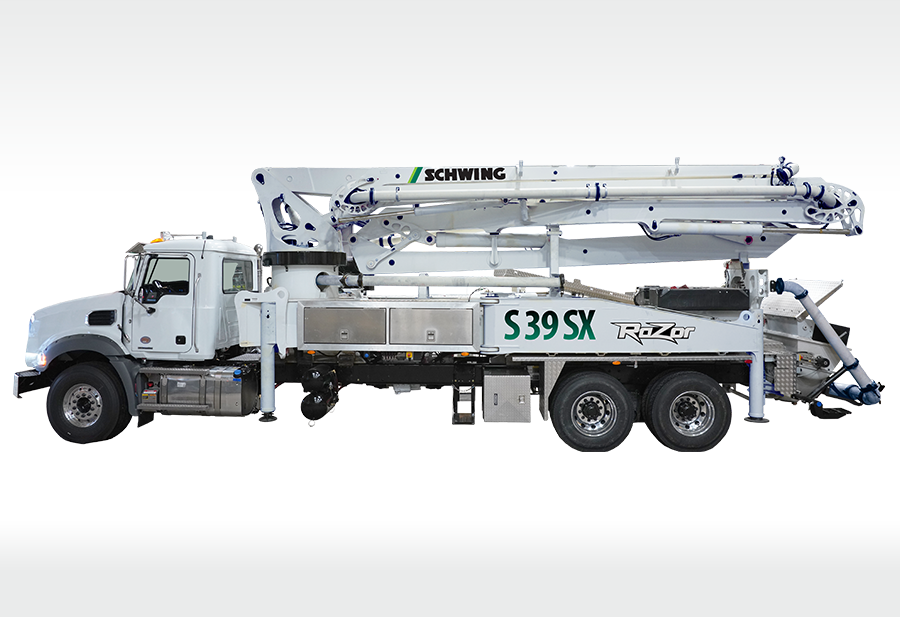
Equipment We Finance in St. Louis We finance concrete pumping equipment at all scales active in the St. Louis metro.
Truck-mounted boom pumps, new and used, 32 to 52 meters Line pumps and trailer-mounted units for historic rehab and smaller sites Stationary concrete pumps for long-run industrial placementsUsed equipment from regional dealers and private sellers Refinancing of existing pump loans Sale-leaseback on owned equipment with equity Transaction minimum is $50k. Applications under about $400k go on an application-only basis. Larger transactions add bank statements. Concrete pumping contractors working the Missouri and Illinois sides of the St. Louis metro both qualify through the same programs.
Choosing the Right Pump for St. Louis Work The medical campus and urban commercial work around downtown and Midtown St. Louis calls for mid-range reach with good maneuverability. A 36-meter boom pump handles most of the multifamily and institutional podium pours in the Central West End and Midtown without overshooting the tight urban sites. Taller structures, the hospital towers and the newer downtown mixed-use buildings, push the requirement out to 42 or 47 meters.
Industrial slab work for the Boeing corridor and warehouse development along I-70 rewards high output volume more than reach. Tilt-up panel pours and heavy equipment bases in those facilities move a lot of yards in a short window, and the pump that earns on those jobs is one with a strong output rate even if the boom length is moderate. A stationary or trailer unit positioned for repeated moves across a large footprint makes sense on those sites.
The historic rehab niche in St. Louis is real money for operators set up for it. Interior concrete placements in narrow alleys, through freight elevator openings, and across tight interior floors require a line pump or a city pump configuration that can thread where a truck-mounted boom cannot go. Operators who add that capability alongside a boom truck have a market angle that most St. Louis pumpers do not cover.
Getting Approved in St. Louis We work with the range of business types and credit profiles that St. Louis concrete operations present. Strong credit gets the best available terms. For operators with prior credit challenges, our B/C credit program evaluates the complete file, including current business revenue and asset quality, not just the score. Bank statements that show consistent revenue from real construction work support approvals that a score alone might not produce.
New businesses qualify through our startup financing track . St. Louis construction experience is a real asset in a startup application. The owner's industry background, personal credit, and the equipment being financed all contribute to the decision. We have funded first-time pump owners in this market repeatedly.
The application-only financing structure covers transactions under roughly $400k without a full financial package. That is the fastest path to an approval decision for most St. Louis operators.
Refinancing and Sale-Leaseback Operators carrying pump loans from higher-rate periods should look at refinancing the existing balance. A lower monthly payment frees up cash flow for maintenance, insurance, or the deposit on the next machine. We handle the payoff to the prior lender and structure the new loan from current market terms.
For St. Louis operators who own a pump outright, a cash-out refinance or sale-leaseback can convert that equity into working capital without giving up the equipment. The capital can fund a hospital campus contract deposit, mobilization costs for a large industrial job, or any other business need where having cash on hand matters.
Questions from St. Louis Area Operators St. Louis and bi-state metro operators ask these questions when evaluating concrete pump financing.
Common questions My company is in Illinois, just across the river from St. Louis. Can I still apply? Yes. The St. Louis market includes significant construction activity on the Illinois side in Collinsville, O'Fallon, and the Metro East corridor. Illinois-registered businesses in the bi-state area qualify without restriction.
I work primarily on hospital renovation projects. Does institutional work affect the financing? Institutional work is typically viewed positively in underwriting. Hospital renovation contracts tend to be longer-term, higher-value engagements with reliable general contractors. That revenue consistency is an asset in the application.
Can I finance a line pump specifically for historic rehab and tight-access commercial jobs? Yes. Line pumps qualify for financing the same way boom pumps do. The transaction minimum applies regardless of pump type. If the line pump is in the $50k range or above, the same programs are available.
I have three months of good bank statement revenue but limited credit history. Can I still get approved? Three months of strong bank statement revenue helps significantly. Thin credit history is different from bad credit, and the underwriting process evaluates both. The asset quality and the business revenue together tell most of the story for operators with limited credit files.
Does Section 179 apply to used concrete pumps, or only new equipment? Section 179 applies to both new and used equipment placed in service. The deduction is not limited to new purchases. Your accountant can confirm the current-year limits and whether the specific asset you are buying qualifies. It is worth the conversation before you decide on structure.
Can I get financing to buy a second pump while I still owe on my first one? Yes. The first loan shows as an existing obligation in underwriting, but it does not automatically prevent a second transaction. Each deal is evaluated on its own merits. A business with strong revenue supporting both payments is a different picture than one where the first payment is already a stretch.
Common Questions on Boom Pump Financing in St. Louis, MO Straight answers before you send the equipment file.
My company is in Illinois, just across the river from St. Louis. Can I still apply? Yes. The St. Louis market includes significant construction activity on the Illinois side in Collinsville, O'Fallon, and the Metro East corridor. Illinois-registered businesses in the bi-state area qualify without restriction.
I work primarily on hospital renovation projects. Does institutional work affect the financing? Institutional work is typically viewed positively in underwriting. Hospital renovation contracts tend to be longer-term, higher-value engagements with reliable general contractors. That revenue consistency is an asset in the application.
Can I finance a line pump specifically for historic rehab and tight-access commercial jobs? Yes. Line pumps qualify for financing the same way boom pumps do. The transaction minimum applies regardless of pump type. If the line pump is in the $50k range or above, the same programs are available.
I have three months of good bank statement revenue but limited credit history. Can I still get approved? Three months of strong bank statement revenue helps significantly. Thin credit history is different from bad credit, and the underwriting process evaluates both. The asset quality and the business revenue together tell most of the story for operators with limited credit files.
Does Section 179 apply to used concrete pumps, or only new equipment? Section 179 applies to both new and used equipment placed in service. The deduction is not limited to new purchases. Your accountant can confirm the current-year limits and whether the specific asset you are buying qualifies. It is worth the conversation before you decide on structure.
Can I get financing to buy a second pump while I still owe on my first one? Yes. The first loan shows as an existing obligation in underwriting, but it does not automatically prevent a second transaction. Each deal is evaluated on its own merits. A business with strong revenue supporting both payments is a different picture than one where the first payment is already a stretch.
Get Terms on Boom Pump Financing in St. Louis, MO Tell us what you are buying, who is selling it, and when you need it earning. We will review the file and point you to the next step.